Walk through any pet store today and you will likely see countless products promoting themselves as grain-free. The message often suggests that removing grains automatically creates a healthier and more natural diet. As a result, many cat owners assume that grain free cat food is always the superior choice. However, the reality is far more complex. While some cats may benefit from certain grain-free formulas, the presence or absence of grains alone does not determine nutritional quality.
Pet food marketing has become increasingly sophisticated. Manufacturers understand that owners want the very best for their pets. Therefore, labels often highlight features that sound appealing, even when the actual benefits are not always clear. Grain-free diets fit perfectly into this trend because they align with the growing interest in natural and minimally processed foods.
Understanding whether grain-free diets truly support feline health requires looking beyond advertising claims. Instead of focusing on a single ingredient category, owners should examine overall nutritional value, ingredient quality, and the specific needs of their cats.
The popularity of grain free cat food continues to grow, yet many misconceptions remain. By separating facts from marketing messages, cat owners can make more informed feeding decisions and choose diets that genuinely support long-term health.
Why Grain-Free Diets Became Popular
The rise of grain-free pet food closely mirrors trends in human nutrition. As grain-free and low-carbohydrate diets gained popularity among people, similar ideas began influencing pet food purchasing decisions.
Many companies started promoting grain free cat food as a more natural option. Marketing campaigns often emphasized the fact that wild cats do not consume grains in significant amounts. Consequently, consumers began associating grain-free products with species-appropriate nutrition.
At the same time, concerns about food allergies and ingredient sensitivities encouraged further interest. Many owners believed grains were common causes of digestive issues and skin problems. As a result, grain-free formulas quickly gained a reputation for being healthier and easier to digest.
However, popularity does not automatically confirm nutritional superiority. While some grain-free diets are excellent products, others simply replace grains with alternative carbohydrate sources that offer similar nutritional functions.
This distinction is important because it highlights the need to evaluate the complete formula rather than focusing solely on a single marketing claim.
Are Grains Naturally Harmful to Cats?
One of the most common assumptions surrounding grain free cat food is that grains are inherently harmful. In reality, healthy cats can digest properly cooked grains without significant difficulty.
Ingredients such as rice, oats, and barley often provide energy, fiber, and certain nutrients. While cats do not have a nutritional requirement for grains, this does not mean grains are automatically dangerous or inappropriate.
Cats are obligate carnivores, meaning they require animal-based proteins for optimal health. However, being an obligate carnivore does not necessarily mean that every non-meat ingredient is harmful. The key issue is ensuring that animal protein remains the primary nutritional focus.
Some pet owners assume that removing grains automatically increases protein content. Although this can be true in some formulas, it is not always the case. Therefore, examining the entire ingredient list remains essential.
The debate surrounding grain free cat food often becomes oversimplified. The more important question is not whether grains exist in the formula, but whether the overall nutritional balance meets a cat’s biological needs.
What Replaces Grains in Grain-Free Diets?
When grains are removed from a formula, manufacturers still need ingredients that help create texture, structure, and energy content. Consequently, alternative carbohydrates often replace traditional grains.
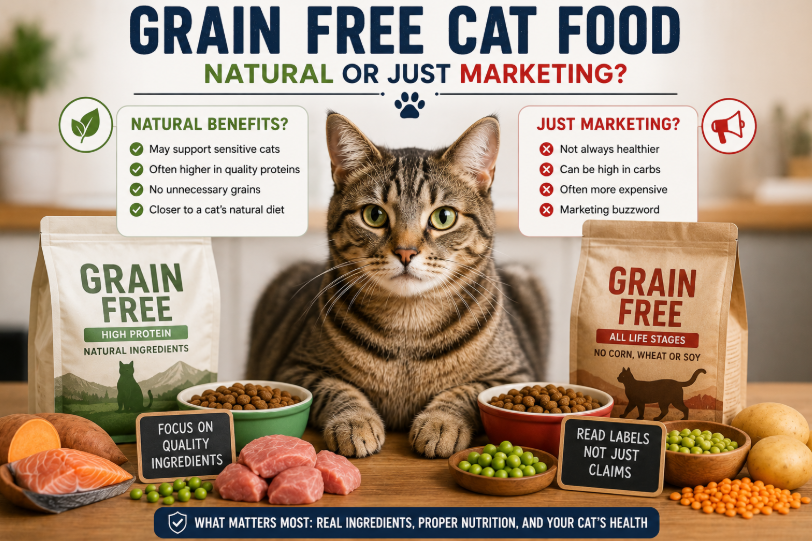
Common substitutes found in grain free cat food include peas, lentils, chickpeas, potatoes, sweet potatoes, and tapioca. While these ingredients may sound more appealing to some consumers, they still contribute carbohydrates to the diet.
This fact surprises many pet owners. Grain-free does not necessarily mean low-carbohydrate. In some cases, carbohydrate levels remain similar to those found in grain-containing products.
Therefore, choosing a grain-free formula solely to reduce carbohydrate intake may not achieve the desired result. Careful label evaluation is necessary to understand the actual nutritional profile.
Ingredient substitutions can also influence digestibility and nutrient composition. Some cats tolerate these alternatives very well, while others may respond differently. Consequently, individual responses remain an important consideration when selecting food.
Rather than focusing exclusively on grain content, owners should evaluate protein quality, ingredient sourcing, and overall nutritional adequacy.
The Relationship Between Food Allergies and Grains
Many consumers purchase grain free cat food because they believe grains commonly trigger allergies. However, veterinary nutrition experts generally report that animal proteins cause food allergies more frequently than grains.
Chicken, beef, fish, and dairy often appear among the most common food allergens in cats. Although grain allergies can occur, they are relatively uncommon compared to protein-related sensitivities.
As a result, switching to a grain-free diet does not always resolve allergy symptoms. If the true trigger involves a protein source, removing grains alone may have little effect.
This misunderstanding contributes significantly to the popularity of grain-free products. Owners may observe improvements after changing foods and assume grain removal was responsible. In reality, the improvement may stem from changes in protein sources, ingredient quality, or overall formulation.
When allergies are suspected, proper diagnosis remains essential. Elimination diets and veterinary guidance provide more reliable answers than marketing claims alone.
Understanding the actual causes of food sensitivities helps owners make better decisions about whether grain free cat food is appropriate for their pets.
Potential Benefits of Grain-Free Formulas
Although grain-free diets are not automatically superior, they can offer benefits in certain situations. Some formulas emphasize high-quality animal proteins and limited ingredients. Consequently, they may align well with the nutritional needs of some cats.
High-quality grain free cat food often prioritizes meat-based ingredients while reducing reliance on lower-cost fillers. In these cases, improved nutrition may result from better ingredient selection rather than grain removal itself.
Certain cats with specific sensitivities may also tolerate grain-free diets more comfortably. However, these situations should be evaluated individually rather than assumed universally.
Many premium grain-free products also focus on ingredient transparency. Owners often appreciate shorter ingredient lists and clearly identified protein sources. This transparency can make food selection easier and improve consumer confidence.
Nevertheless, these advantages stem from overall product quality rather than the absence of grains alone. Therefore, owners should avoid assuming that every grain-free product offers the same benefits.
The best grain free cat food products succeed because they provide balanced nutrition, quality ingredients, and appropriate protein levels rather than simply eliminating grains.
When Grain-Free Becomes Pure Marketing
Marketing plays a major role in the pet food industry. Consequently, some products use grain-free labels primarily as promotional tools rather than meaningful nutritional improvements.
A bag labeled grain free cat food may attract attention even if the formula contains large amounts of alternative carbohydrates. In these cases, the absence of grains creates a marketing advantage without fundamentally changing nutritional quality.
Some consumers also equate grain-free with premium quality. Manufacturers understand this perception and often position grain-free products at higher price points. However, cost alone does not guarantee superior nutrition.
The challenge for cat owners is learning to look beyond packaging claims. Attractive labels and persuasive advertising should never replace careful ingredient evaluation.
Ultimately, a poorly formulated grain-free diet remains a poor diet. Likewise, a well-balanced food containing grains may provide excellent nutrition. Therefore, nutritional quality matters far more than marketing terminology.
Understanding this distinction helps owners evaluate grain free cat food more objectively and avoid making decisions based solely on promotional messaging.
What Matters More Than Grain Content
When selecting cat food, several factors deserve greater attention than grain inclusion. Protein quality remains the most important consideration because cats depend heavily on animal-based nutrition.
High-quality grain free cat food should contain clearly identified animal proteins as primary ingredients. Likewise, foods containing grains should also emphasize meat-based nutrition.
Digestibility matters as well. Foods that support healthy digestion, normal stool quality, and consistent energy levels often indicate good nutritional balance. Ingredient sourcing, manufacturing standards, and nutritional adequacy should also influence purchasing decisions.
Hydration is another critical factor. Wet foods often provide additional moisture that supports urinary and kidney health. Consequently, food format sometimes has a greater impact on health than grain content.
Veterinary guidance can provide valuable insights when selecting diets. Because every cat has unique nutritional needs, personalized recommendations often produce better results than following general trends.
Rather than focusing exclusively on grains, owners should evaluate the complete nutritional picture.
Conclusion
The question of whether grain free cat food is natural or simply marketing does not have a single answer. Some grain-free products offer excellent nutrition and high-quality ingredients. Others rely heavily on marketing while providing little meaningful advantage over traditional formulas.
Grains themselves are not inherently harmful for most healthy cats. Likewise, removing grains does not automatically improve nutritional quality. The most important factors remain protein quality, ingredient balance, digestibility, and overall formulation.
Cat owners should look beyond attractive packaging and focus on evidence-based nutrition. By evaluating the complete ingredient profile and considering individual health needs, it becomes much easier to choose foods that genuinely support feline wellness.
Ultimately, the best diet is not defined by a grain-free label. Instead, it is defined by its ability to provide complete, balanced nutrition that helps your cat thrive throughout every stage of life.
FAQ
1. Are grain-free diets healthier than traditional cat foods?
Not necessarily. Overall nutritional quality matters far more than whether a food contains grains.
2. Do grains commonly cause allergies in cats?
No. Animal proteins are generally more common allergy triggers than grains.
3. Can cats digest grains properly?
Most healthy cats can digest properly cooked grains without significant issues.
4. What ingredients replace grains in these formulas?
Peas, lentils, potatoes, chickpeas, and other carbohydrate sources commonly replace grains.
5. Should I choose a grain-free formula for every cat?
Not always. The best choice depends on your cat’s health, nutritional needs, and individual response to the diet.