Many cat owners focus on protein sources, grain content, and nutritional labels when choosing pet food. However, one important category of ingredients often receives less attention than it deserves. The topic of cat food preservatives dangers has become increasingly important as more pet owners seek healthier and more natural diets for their pets. While preservatives help maintain freshness and extend shelf life, not all preservatives are created equal. Understanding what they do and how they may affect feline health can help owners make more informed decisions.
Preservatives play a practical role in commercial pet food production. Without them, many products would spoil quickly, lose nutritional value, or become unsafe to consume. However, concerns arise when certain synthetic additives are used over extended periods. Consequently, many consumers now examine ingredient labels more carefully than ever before.
The challenge lies in distinguishing between necessary food preservation and potentially questionable additives. Some preservatives have long histories of safe use, while others have generated ongoing debate among pet owners and nutrition experts. Therefore, understanding the facts behind food preservation is essential.
Learning about cat food preservatives dangers does not mean every preserved food should be avoided. Instead, it encourages a balanced approach that prioritizes ingredient quality, transparency, and overall nutritional value.
Why Preservatives Are Added to Cat Food
Pet food contains fats, proteins, vitamins, and other nutrients that can deteriorate over time. Exposure to air, moisture, heat, and light accelerates this process. Consequently, manufacturers use preservatives to maintain freshness and protect nutritional quality.
Understanding the purpose behind preservatives helps place discussions about cat food preservatives dangers into proper context. Without preservation methods, many commercial foods would become unsafe long before reaching store shelves.
Fats present one of the biggest challenges. When fats oxidize, they become rancid and develop unpleasant odors and flavors. More importantly, rancid fats can reduce nutritional value and potentially create health concerns. Therefore, preserving fat quality remains a major priority in pet food production.
Preservatives also help protect vitamins and other nutrients from degradation. As a result, products remain nutritionally consistent throughout their intended shelf life.
Although preservation serves legitimate purposes, the type of preservative used remains an important consideration. Some ingredients raise fewer concerns than others, which is why ingredient labels deserve careful attention.
Natural vs Synthetic Preservatives
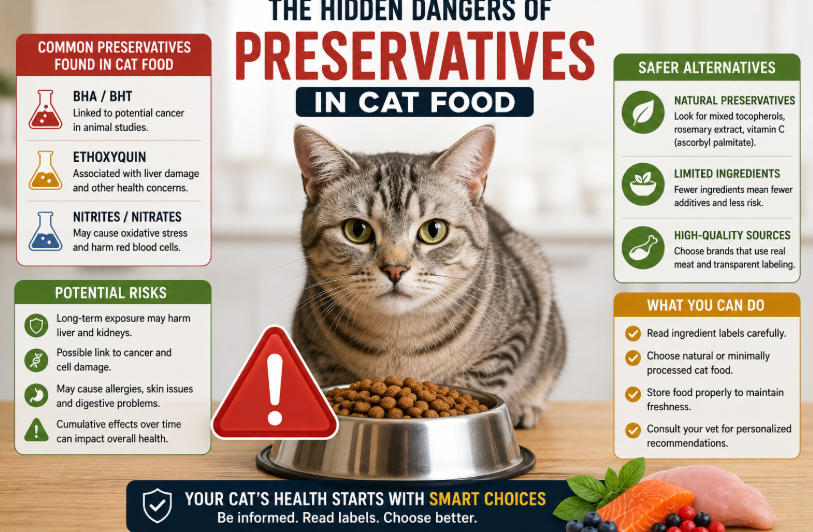
When discussing cat food preservatives dangers, it is important to distinguish between natural and synthetic options. Natural preservatives typically originate from plant-based sources and include ingredients such as mixed tocopherols, rosemary extract, and vitamin C derivatives.
Mixed tocopherols, which are forms of vitamin E, are among the most common natural preservatives found in premium pet foods. They help protect fats from oxidation while supporting product freshness. Similarly, rosemary extract offers antioxidant properties that assist with preservation.
Synthetic preservatives, by contrast, are manufactured compounds designed to provide longer-lasting protection. Some synthetic options have been used for decades and remain approved for pet food use. However, they often generate more concern among consumers.
The discussion surrounding cat food preservatives dangers frequently centers on these artificial additives. While regulatory agencies establish safety limits, some pet owners prefer natural alternatives whenever possible.
Natural preservatives may provide shorter shelf lives compared to synthetic options. Nevertheless, many consumers view this tradeoff as worthwhile because it aligns with their preference for minimally processed ingredients.
BHA and BHT: Common Sources of Concern
Two synthetic preservatives that often appear in discussions about cat food preservatives dangers are BHA and BHT. These compounds have historically been used to prevent fats from becoming rancid.
Manufacturers value these additives because they remain highly effective and help maintain product stability during storage and transportation. However, they have also attracted scrutiny due to findings from certain laboratory studies involving animals.
Although regulatory agencies continue to permit their use within established limits, some consumers remain uncomfortable with these ingredients. As a result, many premium pet food brands have moved toward natural preservation systems.
The presence of BHA or BHT does not automatically mean a product is unsafe. Nevertheless, many owners prefer to avoid them when alternatives are available.
Understanding ingredient labels allows consumers to make choices that align with their comfort levels and feeding philosophies. Consequently, awareness remains one of the most effective tools for evaluating pet food quality.
Ethoxyquin and Ongoing Debate
Another additive frequently mentioned in discussions about cat food preservatives dangers is ethoxyquin. Originally developed as an antioxidant, ethoxyquin has been used in both animal feeds and pet foods.
Over the years, concerns emerged regarding potential health effects associated with long-term exposure. Although regulatory agencies established limits and continued monitoring, public perception shifted significantly.
Many manufacturers voluntarily eliminated ethoxyquin from their formulas in response to consumer demand. Today, it appears far less frequently than it once did. However, its history continues to influence conversations about food additives and ingredient transparency.
The debate surrounding ethoxyquin illustrates an important lesson. Pet owners increasingly expect detailed information about ingredients and manufacturing practices. Consequently, transparency has become a major factor in consumer trust.
Learning about additives like ethoxyquin helps owners better understand why cat food preservatives dangers remain a topic of ongoing interest.
Potential Long-Term Health Concerns
The reason many people research cat food preservatives dangers involves concerns about long-term health effects. While approved preservatives must meet regulatory standards, questions sometimes arise regarding cumulative exposure over many years.
Cats often consume the same food daily for extended periods. Therefore, even small ingredient exposures occur repeatedly throughout a lifetime. This feeding pattern naturally encourages closer examination of food additives.
Some owners worry about potential impacts on liver function, immune health, or cellular processes. Although scientific evidence varies depending on the preservative in question, these concerns motivate many consumers to seek products with simpler ingredient lists.
It is important to note that not every synthetic preservative has been linked to significant health problems. Nevertheless, the desire to minimize unnecessary additives continues driving demand for naturally preserved products.
Balanced decision-making requires considering both available evidence and individual preferences. Consequently, many owners choose foods that prioritize natural preservation methods whenever possible.
How To Read Ingredient Labels
Understanding labels is one of the most practical ways to address concerns about cat food preservatives dangers. Ingredient lists provide valuable information about how products are preserved and what additives they contain.
Natural preservatives often appear as mixed tocopherols, vitamin E supplements, rosemary extract, or ascorbic acid derivatives. These ingredients generally indicate a more natural preservation strategy.
Synthetic preservatives may appear under names such as BHA, BHT, or other chemical designations. Therefore, reading labels carefully helps identify which preservation methods are being used.
Transparency also matters. Manufacturers that clearly explain ingredient functions often inspire greater confidence among consumers. In addition, reputable brands frequently provide detailed information about sourcing and quality-control practices.
Ingredient evaluation should extend beyond preservatives alone. Overall nutritional balance, protein quality, ingredient sourcing, and manufacturing standards remain equally important considerations.
By developing label-reading skills, owners can make more informed choices and better navigate discussions surrounding cat food preservatives dangers.
Choosing Higher-Quality Cat Food
Selecting quality nutrition involves much more than avoiding certain additives. The best products combine balanced nutrition, quality ingredients, responsible manufacturing, and appropriate preservation methods.
When evaluating cat food preservatives dangers, owners should consider the entire formula rather than focusing exclusively on one ingredient category. A naturally preserved food with poor nutritional balance may not be healthier than a well-formulated product using approved synthetic preservatives.
High-quality foods often feature clearly identified animal proteins, transparent ingredient sourcing, and rigorous quality-control standards. Additionally, many premium brands emphasize natural preservation systems and shorter ingredient lists.
Freshness also matters. Proper storage helps maintain product quality regardless of preservation method. Therefore, owners should follow manufacturer recommendations and avoid purchasing products with damaged packaging.
Ultimately, informed decision-making requires evaluating the complete nutritional picture rather than relying solely on marketing claims.
Are All Preservatives Bad?
One of the biggest misconceptions surrounding cat food preservatives dangers is the belief that every preservative is harmful. In reality, preservatives serve important safety functions and help prevent spoilage.
Natural preservatives provide excellent examples. Ingredients such as mixed tocopherols help maintain freshness while contributing antioxidant benefits. Without preservation, food quality could deteriorate rapidly, creating entirely different health concerns.
The goal should not be eliminating every preservative. Instead, owners should focus on understanding ingredient choices and selecting products that align with their preferences and values.
Many modern pet foods successfully balance safety, freshness, and ingredient quality through carefully designed preservation systems. Consequently, consumers now have more options than ever before.
Recognizing the difference between necessary preservation and questionable additives allows for more balanced discussions about feline nutrition.
Conclusion
Understanding cat food preservatives dangers helps pet owners become more informed consumers and advocates for their cats’ health. While preservatives serve important functions by preventing spoilage and maintaining nutritional quality, not all preservation methods generate the same level of confidence among consumers.
Natural preservatives such as mixed tocopherols and rosemary extract have become increasingly popular alternatives to certain synthetic additives. Meanwhile, ingredients like BHA, BHT, and ethoxyquin continue to generate discussion due to historical concerns and evolving consumer preferences.
The most important takeaway is that nutrition should always be evaluated as a whole. Ingredient quality, protein sources, manufacturing standards, and transparency matter just as much as preservation methods. By reading labels carefully and focusing on overall product quality, owners can make feeding decisions that support long-term feline health and well-being.
FAQ
1. Why do pet food manufacturers use preservatives?
Preservatives help prevent spoilage, maintain freshness, and protect nutrients throughout a product’s shelf life.
2. Are natural preservation methods available in cat food?
Yes. Many products use mixed tocopherols, rosemary extract, and other naturally derived antioxidants.
3. Should I avoid foods containing synthetic additives?
That depends on your preferences. Many owners choose naturally preserved products when suitable alternatives are available.
4. How can I identify preservatives on ingredient labels?
Look for ingredient names such as mixed tocopherols, rosemary extract, BHA, BHT, or ethoxyquin.
5. Is naturally preserved food always healthier?
Not necessarily. Overall nutritional quality, ingredient sourcing, and formulation remain equally important.